Cooked, pickled or raw beetroot is the perfect vegetables that can be used all year round. It is rich in protein, fat and carbohydrates. It contains almost everything in the diet are important mineral constituents, as well as many trace elements. It should be noted, that contains a certain amount of cobalt, which participates in the creation of vitamin B12, which is normally found only in foods of animal origin, which is very important for vegetarians. Because the beet one of the best natural remedies for anemia and anemia. Betanin ranks among the medication cycle to fix the blood vessels, regulation of blood pressure and reduce cholesterol. It is also beneficial for osteoporosis. The energy value is quite high at about 190 kJ/100 g.
The form of the fruit cycle is divided into round and cylindrical. He likes a warm and bright and deep lay pognojeno, - humus - loamy soil with plenty of moisture. Asks a lot of potassium. Cylindrical varieties are more demanding than the round, but they are quite enjoyable.
round:
Faro, a red ball Bikor
cylinder:
Cylinder: It forms an oblong roots strong red color. A humble request and drought tolerant. Sown in rows 30 cm spacing. When you grow to 3-4 leaf, it is necessary to thin out at a distance of 10 cm.
Sunday, September 11
Saturday, September 10
Chives
Features
Chives-resistant plant, which grows to 50 cm in height. The root is elongated bulb. Long shoots are narrow, round, tubular leaves, green or gray-green. Between May and August, the peaks grow numerous, dense, purple flowers. The petals are radially spaced and of equal length, diameter 5 cm.
prevalence
It is believed that chives originally grew on the Alpine mountains. Today it is found in hilly regions with warm climate, alpine and arctic Europe, Asia and North America. For growth to be chipped, nutritious and moist soil. Today is mostly grown in greenhouses.
Use
Chives are used since the early Middle Ages. There are different kinds of plants, depending on its height and thickness of leaves. There are also species that blooms with white flowers. Fresh or frozen, less often dried, finely chopped, add it to soups or salads. Long sheets of intersecting, a new growth throughout the year. It is grown as an ornamental plant. The medicinal properties of chives are not known.
Chives-resistant plant, which grows to 50 cm in height. The root is elongated bulb. Long shoots are narrow, round, tubular leaves, green or gray-green. Between May and August, the peaks grow numerous, dense, purple flowers. The petals are radially spaced and of equal length, diameter 5 cm.
prevalence
It is believed that chives originally grew on the Alpine mountains. Today it is found in hilly regions with warm climate, alpine and arctic Europe, Asia and North America. For growth to be chipped, nutritious and moist soil. Today is mostly grown in greenhouses.
Use
Chives are used since the early Middle Ages. There are different kinds of plants, depending on its height and thickness of leaves. There are also species that blooms with white flowers. Fresh or frozen, less often dried, finely chopped, add it to soups or salads. Long sheets of intersecting, a new growth throughout the year. It is grown as an ornamental plant. The medicinal properties of chives are not known.
Tuesday, September 6
Garlic
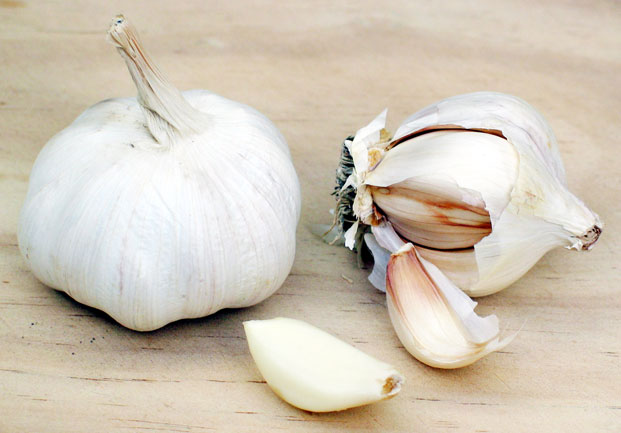
Garlic is an annual or biennial vegetable crops with developed arches. The bulb is made up 10-20 small harbor, cloves, which are wrapped in solid white or reddish dry shell.
In every developed garlic is one vegetative bud, from which the next year developing a new plant. The root of the core, and makes it largely adventitious roots developed in the surface layer of soil. The leaves are narrow, linear-lanceolate, composed of leaf branches that form a false stem and 40-50 cm long stalks. Some ecotypes are formed flower stalks up to 1 m ended peltate bloom in the beginning of wrapped membranes. The flowers are tiny, reddish-purple flowers have six stamens ovaries with multiple ovules. The fruit is a three-piece quiver. The seeds are very small, roundish, black in color and usually sterile, so the garlic does not reproduce seeds. On the inflorescence of garlic can be developed with the air bulb planting breeding buds which to grow plants, but they give a small bulb consisting of a few cloves.
Monday, September 5
Paprika
Paprika comes from South America and in Europe have brought the Spaniards in the 15th century. Over time, the cultivation of pepper has spread throughout the world. Of the countries in the region pepper is grown mainly in Hungary, and we are so famous. Leskovac and the Macedonian peppers.
Paprika is an annual plant, but in tropical regions a perennial plant. Harvest Season is spring-fall, but the use of modern greenhouses, and the speed of transport - contributed to the fresh pepper that is present on our table almost the whole year. In winter it is used Parik sour pickled, canned peppers pickling. Paprika is one of the prized vegetables for their nutritional and medicinal properties.
Types of peppers
Were obtained by crossing different kinds of peppers, a division of the most famous sweet and sour (Havana, cayenne, California, halapenjo, Hungarian, Serrano ...). Peppers can be in shape: conical, prismatic, round, flat and bell (rounded), and in size from several centimeters to several decimetres. As for color, the fruit can be: dark green, yellow-green, straw-colored, white, yellow, orange, and dark red svetlocrveni.
Useful ingredients
Pepper is not as high in calories and is suitable for the diet, but it is rich in minerals, vitamins and other beneficial ingredients. The fruit contains about 89% water.
Paprika contains nutritious, medicinal and other useful satojke:
* Beta-carotene
* Vitamin A
* Vitamin B1
* Vitamin B2
* Vitamin B6
* Vitamin E
* Vitamin C
* Iron
* Glucose
* Essential oils (mainly seed)
* Zeaxanthin
* Potassium
* Kapsacin
* Carotene
* Lutein
* Monosaccharides
* Sodium
* Pantotinsku acid
* Sucrose
* Carbs
* Folic Acid
* Phosphorus
* Fructose
* Citrine
Application in the kitchen
Paprika is used in food storage salad, for storing cooked meals, in various kinds of pickled salad, but also as an aromatic and distinctive flavor (chopped, dried, ground ...).
In addition to sweet peppers, is used and hot peppers, which have special properties, but its role as a spice and a means to improve appetite unsurpassed.
To make the dish more other useful ingredients, it is a short cooking peppers.
It is interesting that as Aromatic peppers used in making some spirits.
Use
The best and richest ingredients useful certainly fresh pepper, and such and most recommended for human consumption.
The ingredients in pepper effect on the human body as follows: antidepressant, aphrodisiac, antirheumatic, antiseptic and diuretic.
Interestingly, the pepper has more vitamin C than lemon and orange. In 100 grams of peppers is 100 mg to 250 mg of vitamin C.
Paprika is an annual plant, but in tropical regions a perennial plant. Harvest Season is spring-fall, but the use of modern greenhouses, and the speed of transport - contributed to the fresh pepper that is present on our table almost the whole year. In winter it is used Parik sour pickled, canned peppers pickling. Paprika is one of the prized vegetables for their nutritional and medicinal properties.
Types of peppers
Were obtained by crossing different kinds of peppers, a division of the most famous sweet and sour (Havana, cayenne, California, halapenjo, Hungarian, Serrano ...). Peppers can be in shape: conical, prismatic, round, flat and bell (rounded), and in size from several centimeters to several decimetres. As for color, the fruit can be: dark green, yellow-green, straw-colored, white, yellow, orange, and dark red svetlocrveni.
Useful ingredients
Pepper is not as high in calories and is suitable for the diet, but it is rich in minerals, vitamins and other beneficial ingredients. The fruit contains about 89% water.
Paprika contains nutritious, medicinal and other useful satojke:
* Beta-carotene
* Vitamin A
* Vitamin B1
* Vitamin B2
* Vitamin B6
* Vitamin E
* Vitamin C
* Iron
* Glucose
* Essential oils (mainly seed)
* Zeaxanthin
* Potassium
* Kapsacin
* Carotene
* Lutein
* Monosaccharides
* Sodium
* Pantotinsku acid
* Sucrose
* Carbs
* Folic Acid
* Phosphorus
* Fructose
* Citrine
Application in the kitchen
Paprika is used in food storage salad, for storing cooked meals, in various kinds of pickled salad, but also as an aromatic and distinctive flavor (chopped, dried, ground ...).
In addition to sweet peppers, is used and hot peppers, which have special properties, but its role as a spice and a means to improve appetite unsurpassed.
To make the dish more other useful ingredients, it is a short cooking peppers.
It is interesting that as Aromatic peppers used in making some spirits.
Use
The best and richest ingredients useful certainly fresh pepper, and such and most recommended for human consumption.
The ingredients in pepper effect on the human body as follows: antidepressant, aphrodisiac, antirheumatic, antiseptic and diuretic.
Interestingly, the pepper has more vitamin C than lemon and orange. In 100 grams of peppers is 100 mg to 250 mg of vitamin C.
Sunday, September 4
Onion
Onion is used as a " young" onions, as well as raw and as ripe onion heads, which can be eaten as raw (salads), or used in cooked dishes. Energy value varies from 180 kJ/100 g for young and up to 1400 kJ/100 g in mature heads. Since nutrients contains the most carbohydrates. But what is most valuable port in the food and in medicinal terms, the content of the mineral substances and vitamins. Minerals has the highest potassium and sulfur, and many oligo-and microelements. Since the medicinal ingredients are the most important glycosides, which give it its characteristic odor and a plant hormone, insulin-like.
Onions are grown mainly by planting a port, but lately more often cultivated by sowing. This increases yield, and such an arc is more resilient and healthier than that obtained from the harbor. For such production, the most pelirano seed, and to achieve high yields should be regularly watered.
What is important is the preparation of the ground. Do not allow manure to fertilize, but being prepared with 8 kg/100 m2 NPK (7:20:30) and for solid foods 2 kg/100 m2 KAN.
Onions are grown mainly by planting a port, but lately more often cultivated by sowing. This increases yield, and such an arc is more resilient and healthier than that obtained from the harbor. For such production, the most pelirano seed, and to achieve high yields should be regularly watered.
What is important is the preparation of the ground. Do not allow manure to fertilize, but being prepared with 8 kg/100 m2 NPK (7:20:30) and for solid foods 2 kg/100 m2 KAN.
Friday, September 2
Asparagus
Asparagus is a perennial shrub-like plant which is a crop-based care with adequate measures can be used 15-20 years.
The underground part of the asparagus makes a well-developed rhizome on whose upper side a number of buds, and on the lower side of the developing root. From the rhizome buds in the spring to develop young bursts of length 15-20 cm thick and up to 4 cm. Plants are green scaly wrapped in thin slices. If the shoots are not cut off from them to develop stalks that can grow up to 1.5 m in height. From armpit scaled leaves develop needle filokladiji that instead of leaves perform photosynthesis.
Asparagus is a dioecious plant separate the sexes. Male plants grow more thin shoots, while female plants develop fewer shoots, but the pulses are thicker.
The flowers are tiny, bell shaped yellow green color with a thin drooping stalks and leaves emerge from the armpit. Plants with female flowers are just flowers with developed pestle, while the stunted stamens. Men's even plants have flowers with 6 stamens, while the pistil rudimentary. Fertilization of female flowers formed fruit. The fruit is red beans containing the seeds. Seeds are angled, rough, black, and a diameter of 3-4 mm. Weight of 1000 seeds is 20 - 25 g. In one gram of seeds is 40-50 seeds.
Specialty of the asparagus and eggs (chop to small pieces and put the lard to fry before they lay eggs), moussaka and lasagne were similar (boil a few minutes before putting the next meal).
The underground part of the asparagus makes a well-developed rhizome on whose upper side a number of buds, and on the lower side of the developing root. From the rhizome buds in the spring to develop young bursts of length 15-20 cm thick and up to 4 cm. Plants are green scaly wrapped in thin slices. If the shoots are not cut off from them to develop stalks that can grow up to 1.5 m in height. From armpit scaled leaves develop needle filokladiji that instead of leaves perform photosynthesis.
Asparagus is a dioecious plant separate the sexes. Male plants grow more thin shoots, while female plants develop fewer shoots, but the pulses are thicker.
The flowers are tiny, bell shaped yellow green color with a thin drooping stalks and leaves emerge from the armpit. Plants with female flowers are just flowers with developed pestle, while the stunted stamens. Men's even plants have flowers with 6 stamens, while the pistil rudimentary. Fertilization of female flowers formed fruit. The fruit is red beans containing the seeds. Seeds are angled, rough, black, and a diameter of 3-4 mm. Weight of 1000 seeds is 20 - 25 g. In one gram of seeds is 40-50 seeds.
Specialty of the asparagus and eggs (chop to small pieces and put the lard to fry before they lay eggs), moussaka and lasagne were similar (boil a few minutes before putting the next meal).
Subscribe to:
Posts (Atom)